
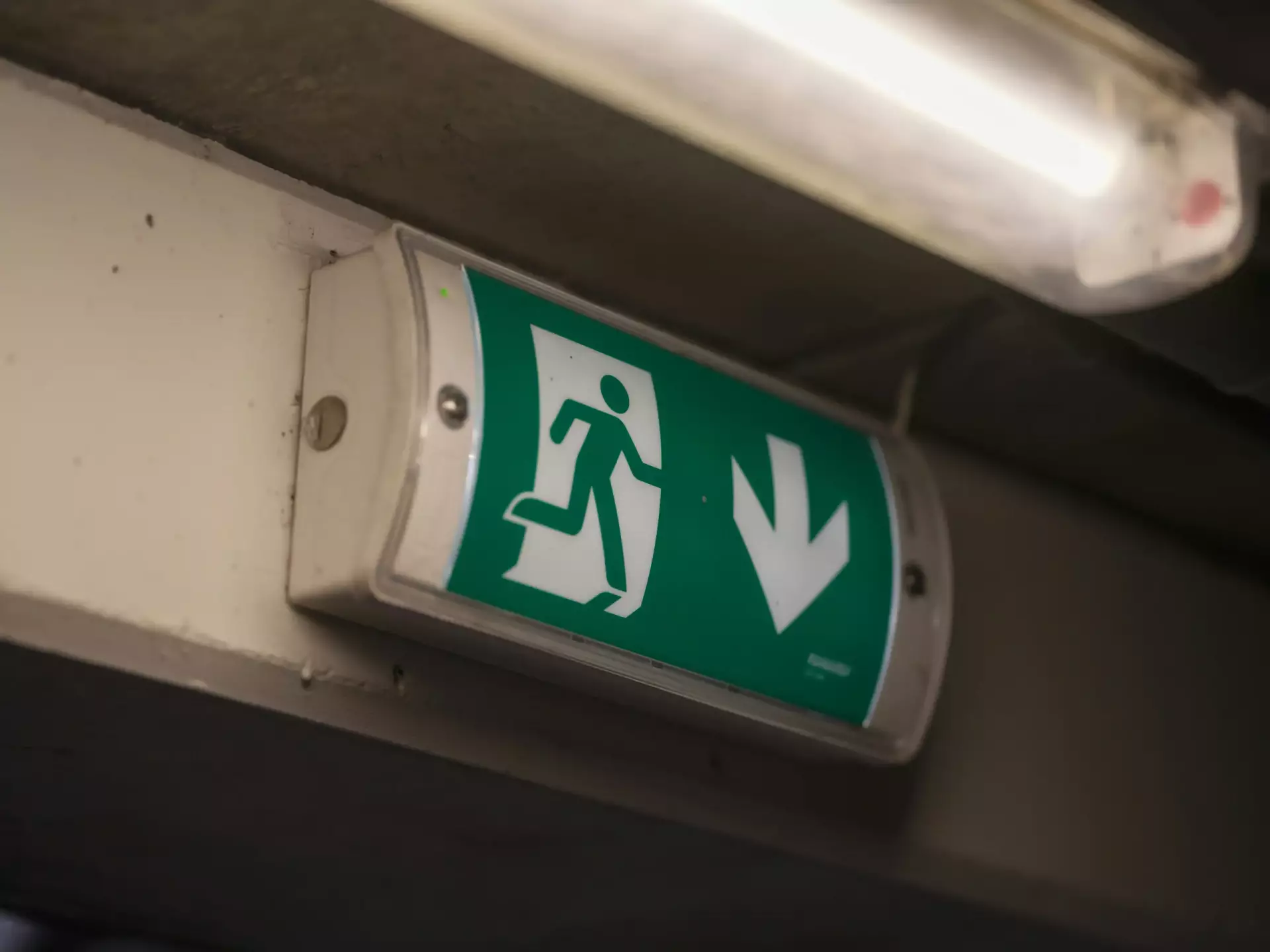
DGUV V3 inspection for emergency lighting: Germany-wide service & fair flat rates
emergency lighting
Reliable safety lighting saves lives in an emergency. If the power fails or a fire breaks out, functioning emergency lights show your employees and customers the safe way out. As an entrepreneur, you are responsible for this safety. The DGUV V3 test (formerly BGV A3) forms the legal basis for this and at the same time protects you from liability risks.
Elektroprüfung Guru is your specialist partner for the nationwide testing of emergency and safety lighting systems. We offer transparent flat rates, legally compliant reports, and a service that is tailored precisely to your processes—whether for a single location or hundreds of branches throughout Germany.
Get started now and calculate your costs directly online. Secure your buildings professionally.
Why regular DGUV V3 inspections are essential
Emergency lighting is often overlooked in everyday life. It usually hangs inconspicuously from the ceiling or above doors. But in the event of a disaster, it becomes the most important part of your fire protection concept. The law therefore stipulates strict controls. These checks are not purely bureaucratic. They ensure that batteries are charged, lights are working, and the switchover works in the event of a power failure.
A failure of safety lighting quickly leads to panic in the dark. People lose their bearings. Obstacles on escape routes become trip hazards. Thick clouds of smoke further impair visibility. Only an intact system can guide people safely to the emergency exit or assembly point.
Safety lighting regulations and liability
The legal requirements are clear. The safety lighting regulations are based on the Occupational Safety and Health Act, the Workplace Ordinance, and the accident prevention regulation DGUV Regulation 3. Failure to comply with these obligations may result in severe penalties in the event of damage. Insurance companies often refuse to pay if no valid test certificate is available.
We help you minimize these risks. Our experts test strictly in accordance with the applicable standards (such as DIN VDE 0100-718, DIN EN 50172). With our test sticker and detailed maintenance log, you can prove at any time that your systems have been properly maintained.

Your advantage: Emergency lighting maintenance prices with no surprises
Many service providers work with opaque cost structures. Travel costs are charged separately, and small parts are charged extra. We take a different approach. Our model is particularly attractive for chain stores and companies with multiple locations. We offer you uniform conditions nationwide.
With us, you get clarity about emergency lighting maintenance prices. We calculate fair flat rates per light or per location. This makes your budget planning much easier. Our technicians are networked throughout Germany. This allows us to keep travel costs low and respond flexibly to your appointment requests.
Your advantage: Emergency lighting maintenance prices with no surprises
- Nationwide coverage: We perform inspections in Hamburg just as reliably as in Munich, Berlin, or rural areas.
- All-inclusive: Travel to and from the site, measuring equipment, and documentation are included in the offer.
- Legal certainty: You receive a legally binding test report for each system.
- Minimal disruption: We carry out the DGUV V3 test in such a way that your operations are hardly affected.
Examination procedure: We check the following in detail
A simple visual inspection is often not enough. Modern emergency lighting systems are complex electrical engineering systems. When testing, we generally distinguish between two types of systems: centrally powered systems and self-contained single-battery luminaires. Specific standards apply to both variants.
If necessary, our experts also carry out a lux measurement. This ensures that the required illuminance (at least 1 lux in the center of the escape route) is actually achieved. Aging and contamination of the lights can cause these values to deteriorate over time.
Testing networked systems (central battery)
In large buildings, a central battery system usually supplies all emergency lights. Here, we test in accordance with DIN EN 50172 and VDE 0108 Part 100. The focus is on the central switching device and the final circuits. Our check includes:
- General visual inspection of the system and lights for external damage.
- Inspection of cable entries and connections.
- Function test of the trigger (simulated power failure).
- Duty cycle test (capacity test over approx. 3 hours).
- Mechanical inspection of the central batteries.
- Checking the battery terminals for oxidation and secure fit.
Testing of self-sufficient systems (single battery)
Single-battery lights are often used in smaller buildings or as a supplement. Each light has its own battery. Testing is carried out in accordance with DIN VDE 0105-0100 and DIN EN 1838. Here, we pay particular attention to the condition of the individual batteries:
- Visual inspection for damage to the housing.
- Checking the charge indicator (LED).
- Triggering of the function test (power failure simulation).
- Operating time test of the batteries (approx. 1 to 3 hours depending on specifications).
- Testing of the light sources for full luminosity.

DGUV V3 Prüfungen in ganz Deutschlands
+49 (0) 211 2204320
office@elektropruefung.guru